



Scotland has a long history of international trade.
In 2024 the UK recorded 853 FDI projects. Scotland performed particularly well – placing sixth in the best-performing investment regions in Europe, with US-based companies being the key investor in the majority of projects. Despite global headwinds, Scotland and the UK market continued to appeal as a top-tier investment destination.
The Scottish government has traditionally offered significant support to many Scottish businesses, whether it be funding to secure jobs, tax reliefs, or financial support for innovation and R&D. Scotland continues to offer significant incentives in the form of grants or subsidies to foreign investors, with Scottish Enterprise budgeting around £300 million per year while Highland and Islands Enterprise supported 339 projects in the 2023/2024 financial year and provided £57m in support.
In 2023, Scotland recorded 142 projects, which was a 14% increase from 2022 and a record for Scotland, making it the leading investment region in the UK outside of London. The investment sectors in Scotland during 2023 that contributed most to this success were renewable energy and offshore wind investments.
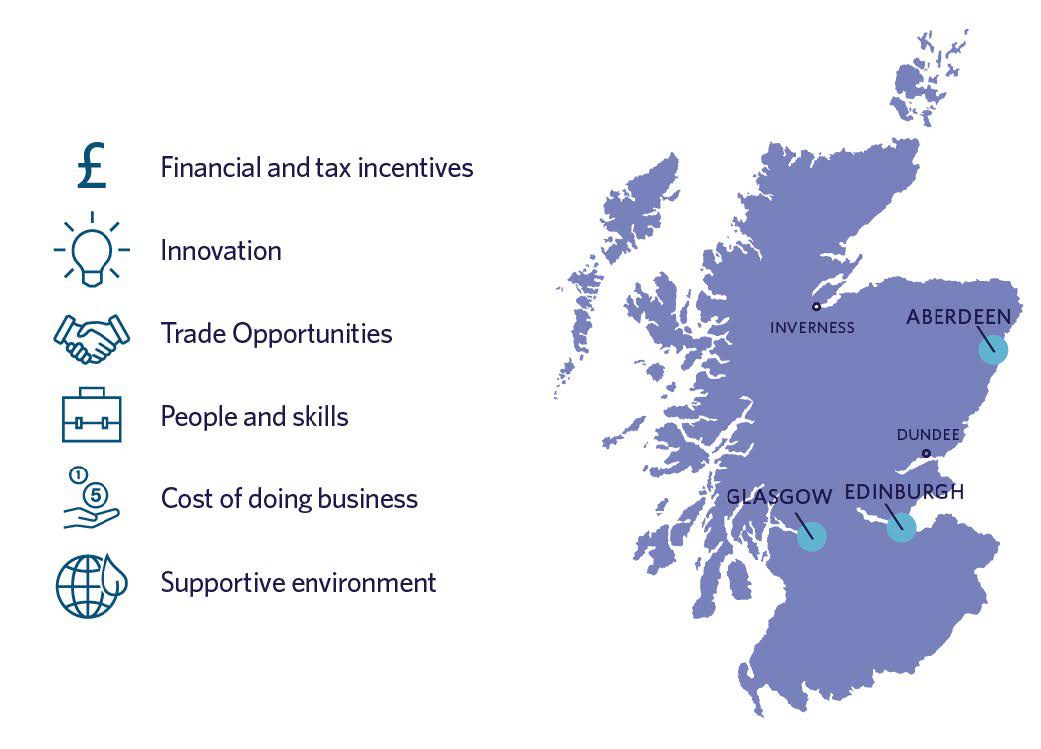
A major benefit of the Scottish market is that companies can be established within 24 hours, and it is easy to see why so many choose to locate here. With extensive travel links, including the largest ports industry and air transport system in Europe, Scotland and the UK offers proximity and easy access to customers, suppliers and partners.
Similarly to UK, Scotland has a single, transparent corporation tax rate of 25% for all resident companies with profits of £250,000 or more. In Scotland, a small profit rate of 19% applies to businesses with profits of £50,000 or less. The 19% rate also applies to overseas companies with a UK branch. This is the lowest rate in the G7.
While London continues to attract the largest share of the UK’s FDI, there are many other cities around the UK which serve as an excellent bases for setting up a business including Manchester, Birmingham, Glasgow and Edinburgh.
It is important to note that the UK is comprised of different legal jurisdictions and although there are many similarities, there are different legal and regulatory compliance requirements across Scotland, England, Wales and Northern Ireland. This guide looks at the UK as a whole while noting some important legal differentiations between England and Scotland.
This guide is aimed at businesses who are looking to expand or invest into Scotland. At Burness Paull, we are passionate about supporting businesses as they establish and grow. While this guide does not constitute legal advice, it provides a high-level overview of key requirements for entering the Scottish market. We recognise that every business faces different challenges and complexities, and our approachable team is here to support you through each step of the process.
Related News, Insights & Events
Error.
No results.

Financial Conduct Authority fends off challenge to decision to name firm under investigation
17/03/2026
A recent court challenge a Financial Conduct Authority’s decision to name a firm at the outset of an investigation has shown how the “exceptional circumstances” test works.

All is fair in fair notice: the importance of specification and fair notice in professional negligence claims
12/03/2026
The recent decision in J&M Properties v George Weightman [2026] SC AIR 12 echoes the long-standing principle that specification and the provision of fair notice is essential for effective pleadings.

New SBCC contracts explained: key changes and what they mean for your projects
10/03/2026
Here, we discuss the rollout of the new SBCC 2024 contracts and key changes, including legislative alignment, sustainability, collaboration and modernised provisions affecting construction projects.
{name}
{properties.pageSummary}
{properties.headline}
{properties.pageDate|date:dd/MM/yyyy}
{properties.shortDescription}
{properties.eventName}
{properties.pageDate|date:dd/MM/yyyy}{properties.shortDescription}
